
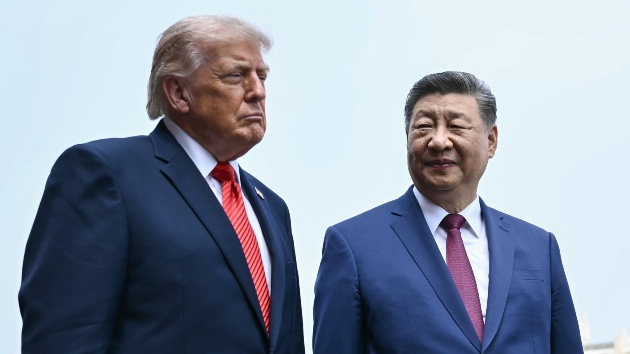
(WASHINGTON) — After a second day of high-stakes meetings with China’s Xi Jinping, President Donald Trump is not committing to approving the latest round of arms sales to Taiwan and brushed off previous U.S. assurances not to consult with Beijing about those sales.
“I’ll make a determination over the next fairly short period,” Trump said when asked about the arms sales by reporters aboard Air Force One.
The president’s remarks came after Xi’s stark warning that if the issue of Taiwan is handled “improperly,” then the two nations could “come into conflict,” according to China’s official state news source Xinhua. However, Xi did say that if the issue is handled “properly” then “bilateral relations can remain generally stable.”
Trump has been delaying the latest round of arms sales, for months refusing to sign off on the record $14 billion package that was approved in January 2025, despite urging from some lawmakers.
Trump also told reporters that Xi asked him if he would come to Taiwan’s defense if China were to attack, but Trump claims to have not revealed his thinking.
“That question was asked to me today by President Xi. I said, ‘I don’t talk about, I don’t talk about that,"” Trump said.
Taiwan’s Mainland Affairs Council Deputy Minister Liang Wen-chieh said they are “paying close attention” to the Trump-Xi meeting.
Earlier Friday, Trump participated in a tea and working lunch with Xi.
On Iran, Trump said he and Xi feel “very similar” in wanting the war to end and prohibiting Iran from obtaining a nuclear weapon.
“We feel very similar in Iran. We want that to end. We don’t want them to have a nuclear weapon. We want the [Strait of Hormuz] opened. We’re closing it now. They closed it, and we closed it on top of them, but we want the straits open, and we want them to get it ended, because it’s a crazy thing,” Trump said at a photo opportunity earlier Friday.
Later, aboard Air Force One, Trump was pressed on whether Xi actually committed to pressuring Iran to reopen the Strait of Hormuz.
“I’m not asking for any favors, because when you ask for favors, you have to do favors in return. We don’t need favors,” Trump said.
Trump was seeking to bolster international support amid a push to reopen the Strait of Hormuz as the U.S. war with Iran stretches on. China is Iran’s principal oil consumer.
The Chinese Foreign Ministry, responding to inquiries to confirm whether Trump and Xi discussed Iran, sidestepped the question but reiterated China’s position that the ceasefire and negotiations should continue and that the Strait of Hormuz should be reopened.
“There is no need to continue this war that should not have happened,” a spokesperson for the Foreign Ministry said. “Finding a solution earlier is beneficial to the United States and Iran, as well as to the countries in the region and even the whole world.”
“Since the door of dialogue is open, it should not be closed again,” the spokesperson said.
Before Friday’s meeting, Trump met Xi to tour the gardens at Zhongnanhai, the Chinese Communist Party leadership compound.
Xi said he picked the location “especially to reciprocate the hospitality extended to me in 2017 at Mar-a-Lago.” Xi said Trump was interested to learn about the plants in the garden including the Chinese roses. Xi said he “agreed” to gift Trump seeds for those roses.
Tech and trade have also been key themes during the talks. Trump said the two leaders “made some fantastic trade deals.”
CEOs Elon Musk of Tesla and SpaceX, Tim Cook of Apple and Jensen Huang of NVIDIA, among others, traveled with the president to Beijing. Trump said the business leaders joined him to “pay respects” to Xi.
The White House said one of Trump’s goals going into the summit with Xi is to secure purchasing agreements with China in the aerospace, agriculture and energy sectors and the CEOs traveled with the president to help push for that.
Trump said Xi agreed to initially purchase 200 Boeing planes, which could go up to 750 planes if all goes well. Boeing has not confirmed this deal, referring inquiries to the White House.
Trump also said China has agreed to buy “billions of dollars” of soybeans, though he didn’t get into specifics.
U.S. Trade Representative Jamieson Greer had said on Friday that the U.S. expects China to buy tens of billions of dollars worth of American agricultural products in the next few years.
“We expect to also see an agreement for double-digit billion purchases … over the next three years, per year, coming out of this visit, and that’s more general, that’s aggregate, that’s not just soybeans, that’s everything else,” Greer told Bloomberg.
ABC News’ Karson Yiu, Mariam Khan, Michelle Stoddart and Kevin Shalvey contributed to this report.
Copyright © 2026, ABC Audio. All rights reserved.
Never miss out on local news. Sign up below for Tri-County Insider News:


