
(NEW YORK) — A rare asteroid will soon be visible to the naked eye in a rare celestial event, according to astronomers.
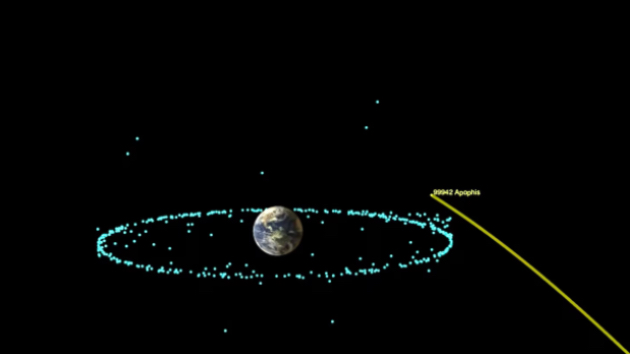
Asteroid 99942 Apophis – named after the Egyptian deity of chaos, darkness and fire – is expected to safely pass close to Earth on April 13, 2029, according to NASA.
The asteroid will pass within roughly 20,000 miles of Earth – nearly 12 times closer than the moon’s average distance from Earth, and closer than many satellites in geosynchronous orbit – making it one one of the closest approaches ever recorded for an object if its size and a “very rare event,” according to NASA.
The approach will be visible to observers on the ground in the Eastern Hemisphere, weather permitting, according to NASA. It will be close enough that sky-watchers won’t need a telescope or binoculars to see it, astronomers say.
When Apophis was first discovered in 2004, it was labeled a potentially hazardous asteroid because of the possibility that it could impact Earth in 2029, 2036 or 2068, according to NASA.
After closely tracking the asteroid and its orbit using optical telescopes and ground-based radar, astronomers are now confident that there is no risk of Apophis impacting Earth for at least 100 years.
The Earth’s gravitational pull could change the asteroid’s orbit around the sun as it passes in 2029, making the orbit slightly larger or the orbital period slightly longer, but the risk of impact with Earth will remain the same, NASA says. Its close passage will also afford astronomers around the world the opportunity to learn more about the asteroid.
Apophis is the Greek name for the Egyptian god known as Apep. The name was proposed by the astronomers who discovered the asteroid: Roy Tucker, David Tholen and Fabrizio Bernardi of the Kitt Peak National Observatory near Tucson, Arizona.
The asteroid is a relic of the early solar system from about 4.6 billion years ago, made of leftover raw material that was never part of a planet or moon, according to NASA. Though its exact size and shape is unknown, it has a mean diameter of about 1,115 feet and a long axis of at least 1,480 feet.
Apophis’ surface is weathered due to eons of exposure to space weather, including solar wind and cosmic rays, according to the Massachusetts Institute of Technology.
Observatories around the world and in space will observe the asteroid’s historic approach to Earth in order to better understand its physical properties.
NASA has redirected a spacecraft to rendezvous with Apophis shortly after its close approach in 2029, while the European Space Agency is sending a spacecraft to study it.
When the April 2029 flyby occurs, Apophis will become a member of the “Apollo” group, the family of asteroids that cross Earth’s orbit but that themselves have orbits around the sun that are wider than the Earth’s, according to the ESA.
Copyright © 2026, ABC Audio. All rights reserved.
Never miss out on local news. Sign up below for Tri-County Insider News: